



 English

Aluminum is one of the most popular Materials in modern manufacturing. Its lightweight properties, excellent machinability, corrosion resistance, and cost-effectiveness make it the preferred choice for Industries ranging from automotive and electronics to aerospace and industrial equipment.
However, for many custom CNC aluminum parts, machining is only the first step.
To improve corrosion resistance, increase surface hardness, and achieve a professional appearance, anodizing has become one of the most widely used surface finishing processes for CNC-machined aluminum components.
At Jiesheng Hardware, the manufacturing team behind CNCPartsChina.com, we provide complete aluminum CNC machining and anodizing services for customers worldwide. Whether you're developing prototype aluminum parts, low-volume production runs, or large-scale OEM projects, anodizing plays a critical role in maximizing product performance and longevity.
What Is Anodizing?
Anodizing is an electrochemical surface treatment process that converts the outer layer of aluminum into a durable aluminum oxide coating.
Unlike paint or plating, the anodized layer becomes part of the aluminum itself rather than sitting on top of the surface.
This creates a finish that offers:
Excellent corrosion resistance
Increased wear resistance
Improved surface hardness
Better electrical insulation
Enhanced appearance
Long-lasting color retention
Because of these benefits, anodizing is one of the most common finishing methods used for precision CNC machined aluminum parts.
Why Anodizing Is Important for cnc machined aluminum parts
Many aluminum alloys already offer natural corrosion resistance.
However, industries such as automotive, aerospace, marine, electronics, and industrial automation often require additional protection.
Without anodizing, aluminum parts may experience:
Surface scratches
Oxidation
Environmental wear
Cosmetic degradation
Anodizing creates a protective barrier that significantly extends the lifespan of custom CNC aluminum components.
For manufacturers producing high-value products, anodizing also improves the perceived quality of the final assembly.
Benefits of Anodized CNC Aluminum Parts
Superior Corrosion Resistance
One of the biggest advantages of anodizing is protection against corrosion.
Anodized aluminum performs exceptionally well in:
Outdoor environments
Humid conditions
Industrial facilities
Automotive applications
Marine environments
This makes anodizing ideal for custom CNC machined parts exposed to harsh operating conditions.
Increased Surface Hardness
The anodized oxide layer is significantly harder than untreated aluminum.
Benefits include:
Better wear resistance
Reduced scratching
Improved durability
Longer product life
For frequently handled products such as electronic enclosures and industrial equipment housings, this additional protection is extremely valuable.
Professional Appearance
Anodizing creates a clean, uniform finish that enhances product aesthetics.
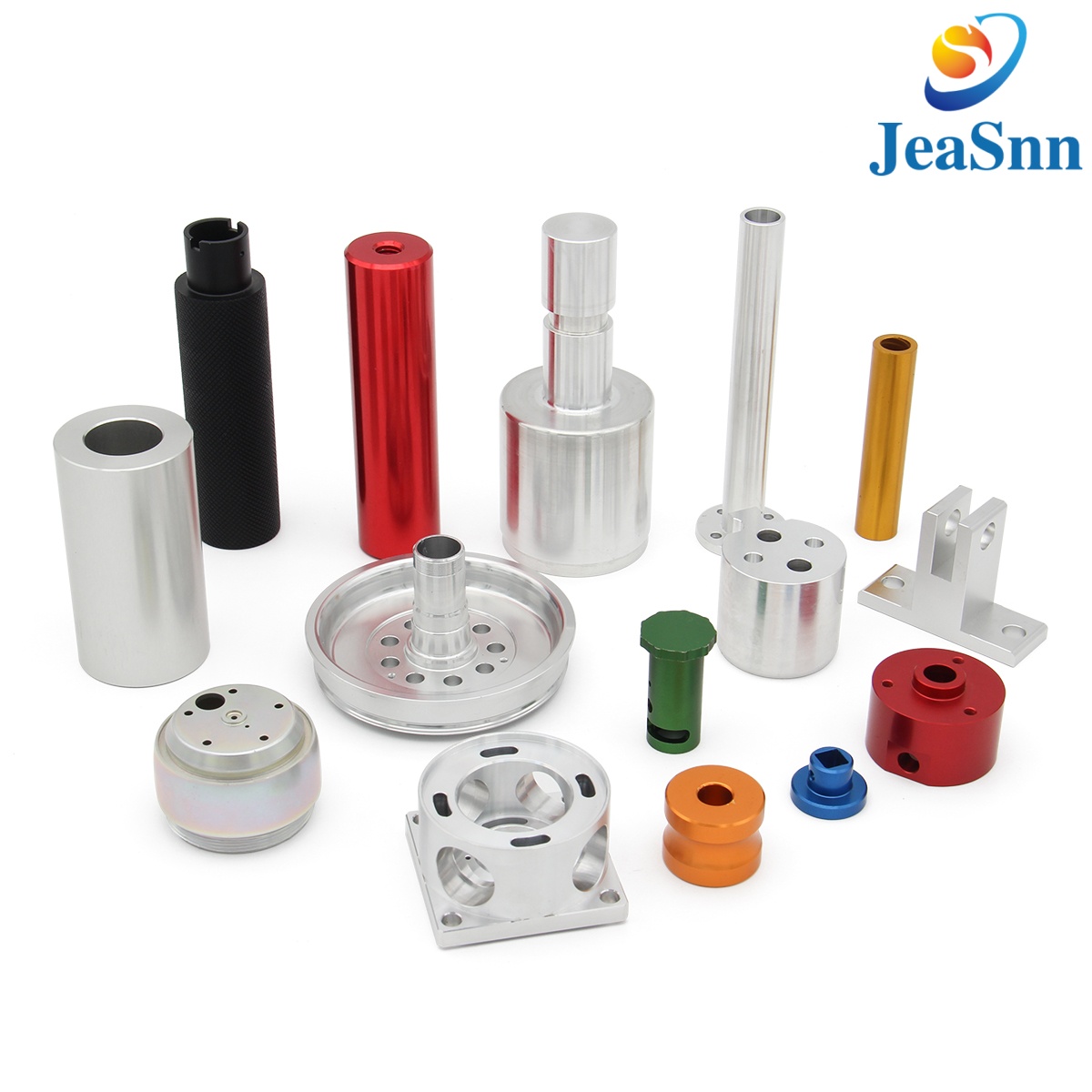
Popular anodized colors include:
Black anodized aluminum
Clear anodized aluminum
Red anodized aluminum
Blue anodized aluminum
Gold anodized aluminum
Many customers choose anodizing because it provides a premium appearance while maintaining the precision details of CNC machined parts.
Better Dimensional Stability
Unlike powder coating or painting, anodizing adds only a very thin layer to the surface.
This makes it ideal for:
Precision assemblies
Tight tolerance components
Mechanical interfaces
Aerospace applications
At JeaSnn, many high-precision CNC machined aluminum components require anodizing without compromising dimensional accuracy.
Choosing the Right Type: Type II vs. Type III Anodizing
Not all anodizing is created equal. Depending on your part's application, our engineering team at JeaSnn typically deploys two main variants:
Type II Anodizing (Decorative / Commercial Anodizing)
This is the most common standard for everyday industrial components. Utilizing a sulfuric acid bath, it creates a relatively thin oxide layer (typically 5 to 25 microns).
When to deploy: If your primary goals are basic corrosion defense, surface scratch resistance, and brilliant cosmetic color styling (like faceplates or drone brackets).
Type III Anodizing (Hardcoat Anodizing)
Hardcoating is performed under much lower temperatures and higher electrical currents. It forces a much thicker, denser oxide layer (50 to 100 microns) into the metal.
When to deploy: Reserved for high-stress military, marine, or industrial applications where the component encounters extreme abrasion or heavy mechanical load (like sliding rails, hydraulic cylinders, and gears).
The Engineer’s Checklist: Managing Tolerances and Surface Prep
As a specialized CNC machining parts manufacturer, we always remind clients that anodizing alters the physical dimensions of your parts:
The Dimensional Growth Rule: Anodizing is a "reactive" coating. Half of the layer grows into the metal, and half builds up on top of the surface. For example, a 20-micron Type II layer will increase the overall outside diameter of a cylindrical custom CNC lathe part by roughly 20 microns (10 microns per side).
Tolerances Control: If your blueprints demand tight tolerance CNC machining (like±0.005mm for bearing seats), our machinists will pre-calculate the material removal rate during the milling or turning phase to ensure the final dimension is mathematically perfect post-anodizing.
The Power of Sandblasting: Prior to the chemical bath, we highly recommend Sandblast Anodized processing. Blasting the raw aluminum with fine glass beads or grit creates a uniform matte texture that perfectly conceals directional tool marks from the CNC milling cutter.
Optimize Your Component Aesthetics and Longevity
Ready to source premium, factory-direct anodized parts from China? Don't let processing variables delay your production schedule.
Upload your 3D CAD models (STEP/IGES) or detailed 2D PDFs to our engineering desk today. We will provide a comprehensive Design for Manufacturing (DFM) review to help you choose the ideal material grade and anodizing thickness for your budget and application.
Direct RFQ Desk: engineer@cncpartschina.com